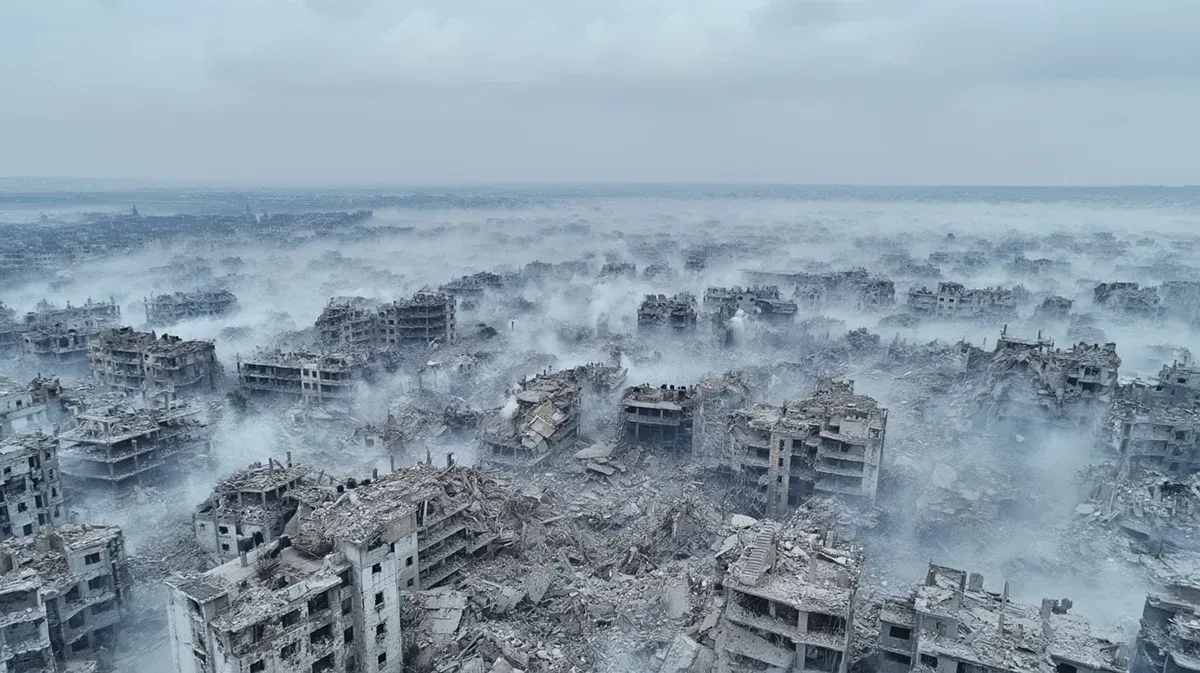
Climate and Community Institute estimates that the first 14 days of the war, from February 28 to March 14, 2026, generated roughly 5.05 million tonnes of CO2e.
The important point is not only the scale. It is where the emissions came from. The largest share in their estimate was not the strike itself, but the material destruction left behind: 2.415 million tonnes CO2e from damaged homes and buildings alone. Destroyed fuel accounted for another 1.883 million tonnes, followed by combat and support operations, lost military equipment, and missiles and drones that will have to be replaced.
The core fact is brutal: the biggest emissions source is often not the attack, but the carbon-intensive wreckage the attack leaves behind.
That is what makes war a climate regime rather than a single emissions event. It does not stop at fire and blast. It keeps emitting through cement, steel, debris removal, reconstruction, replacement supply chains, and emergency energy improvisation.
Live Science, citing the same analysis, noted that more than 16,000 homes, thousands of commercial units, 77 medical facilities, and 69 schools were damaged or destroyed in the underlying assessment. That matters because every ruined structure becomes future emissions in waiting. War does not just destroy in the present. It locks in carbon for years afterward.
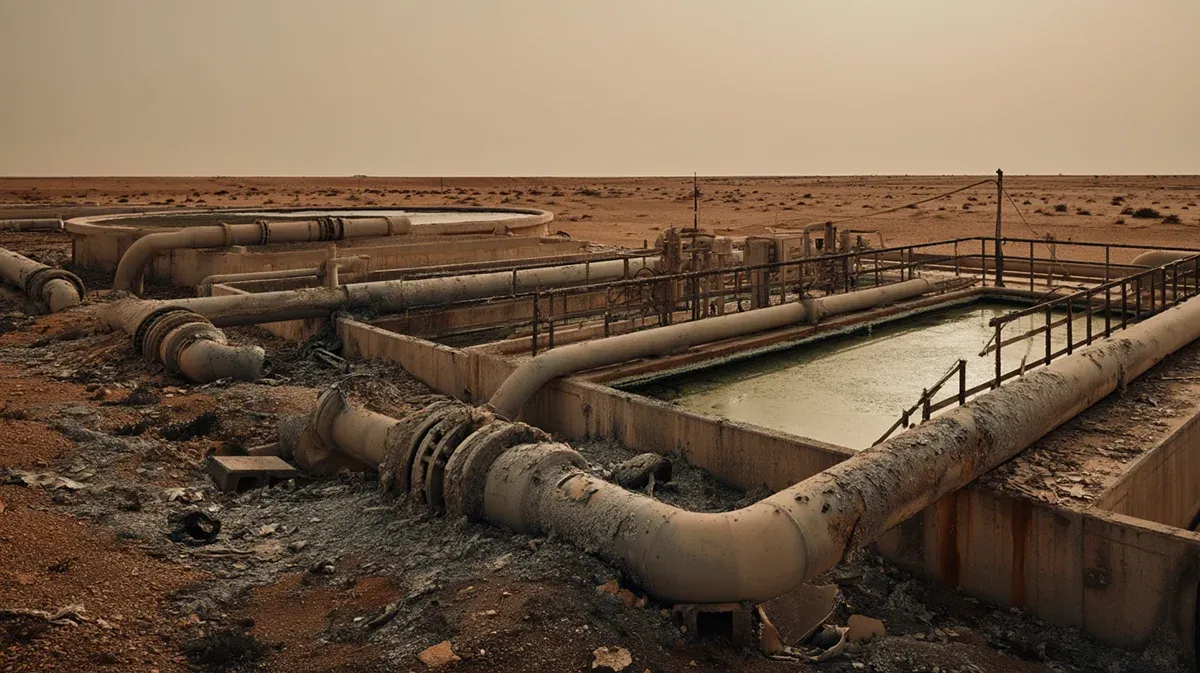
A damaged industrial water facilit.War leaves behind a long environmental costs beyond the moment of attack.
The damage also spills well beyond the battlefield. AP and CEOBS have both described toxic air, polluted water, agricultural damage, threats to drinking water, and harm to marine ecosystems, alongside risks tied to chemicals, heavy metals, and damaged desalination infrastructure.
CEOBS says conflict-related pollution is the most immediate environmental threat, especially where drought and water stress were already severe. In other words, war’s environmental cost is not only atmospheric. It is also biological, chemical, and infrastructural. Climate damage and public-health damage arrive together.
Then the shock spreads into the wider economy. Reuters reported on March 26 that the war was pushing Europe to weaken or delay parts of climate policy as energy security again took precedence over emissions cuts. That example matters because it shows that war does not only emit directly. It also reorganises political priorities around fossil security.
AP reported that several Asian countries were increasing coal use as LNG supplies were squeezed by the conflict and the instability around Hormuz. The effect is not confined to bombed territory. War pushes energy systems back toward dirtier fuels when the pressure hits hard enough.
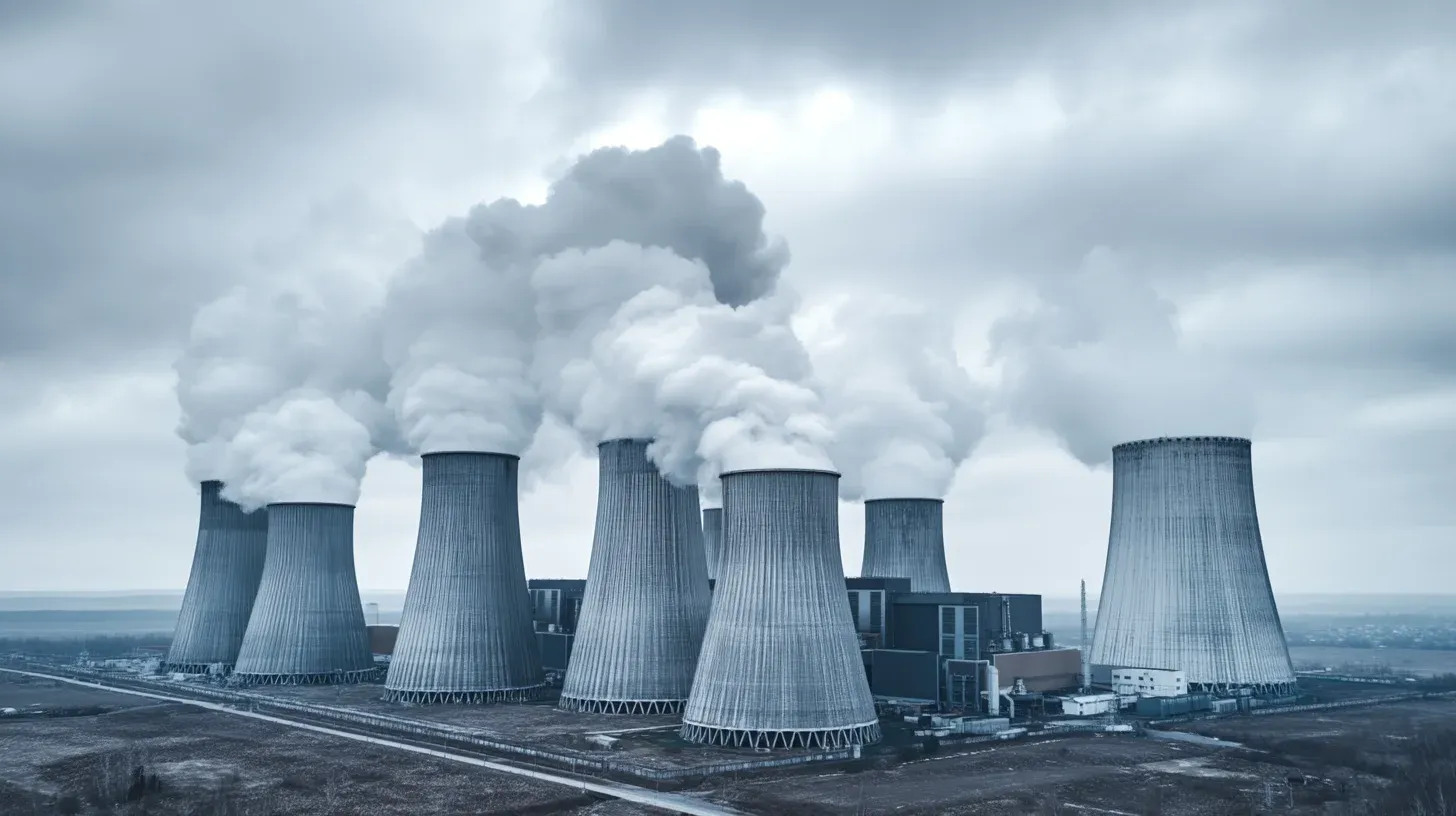
War-driven energy shocks can push systems back toward carbon-intensive generation.
Shipping tells the same story in motion. Reuters has documented vessels rerouting around the Cape of Good Hope, while African bunkering hubs benefit from ships avoiding Suez, Bab el-Mandeb, and Hormuz. Longer routes mean more fuel burned and more carbon emitted.
Reuters had already reported in 2024 that Red Sea diversions significantly increased emissions per ship, and UNCTAD has since pointed to the rise in ton-miles caused by such rerouting. The climate effect of war does not end at the crater. It continues in longer routes, higher bunker use, and a more carbon-intensive circulation of goods.
That is why the biggest political problem is not only undercounting. It is selective counting. CEOBS has shown that military emissions reporting remains weak, and that the largest military powers either do not report properly or leave major gaps. Their work on the “military emissions gap” makes the deeper problem plain: war and militarisation still sit at the edge of the climate ledger, while ordinary civilian consumption sits at its center.
So a moral asymmetry emerges. Citizens are told to fly less, consume less, and decarbonise daily life, while some of the most carbon-intensive activities in the world are still treated as if they lie outside the main field of climate accountability.

Everyday carbon discipline and large-scale systemic emissions.
This is the real scandal. Not only that war emits enormous amounts of carbon, but that these emissions are still treated as a side issue while climate discipline is aimed downward at far smaller sources in ordinary life.
The point is not that personal emissions do not matter. It is that war remains one of the darkest blind spots in the whole accounting system.
The deeper truth is that war does not sit outside the climate crisis. It is one of its engines. It produces emissions in the blast, then reproduces them through ruins, rebuilding, shipping detours, fossil fallback, and political rollback. As long as war and militarisation are treated as exceptions to the climate ledger, one of the most carbon-intensive forces in the world will remain politically underlit. That is not a gap in the story. It is part of how the story is being told.
Sources used:- Climate and Community Institute, Research Snapshot: Emissions from first 2 weeks Iran- VG, Iran-krigen fører til enorme klimautslipp- Live Science, summary of the Climate and Community Institute analysis- Associated Press, reporting on the environmental toll of the Iran war- CEOBS, Iran War: Environmental risk overview- CEOBS, A framework for military greenhouse gas emissions reporting- CEOBS / Military Emissions Gap reporting- Reuters, March 26, 2026, on Europe scaling back climate goals under war-driven energy pressure- Associated Press, reporting on increased coal use in Asia as LNG supplies tighten- Reuters, reporting on African bunkering gains from rerouted shipping- Reuters, 2024 reporting on Red Sea diversions and higher shipping emissions- UNCTAD, maritime transport reporting on longer routes and rising ton-miles