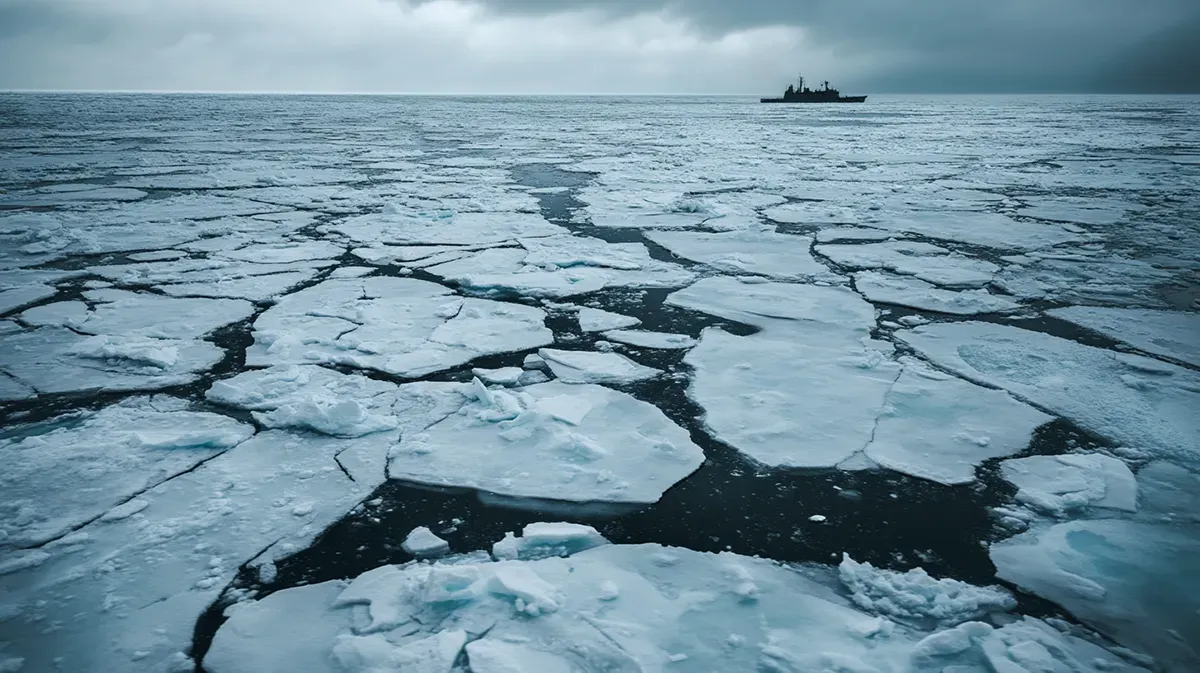
For decades, sea ice acted as a physical brake on Arctic activity. It raised costs, restricted movement and imposed risks that kept much of the region difficult to exploit.
As that brake weakens, the market does not simply take over. The state becomes more important, not less. Those able to set rules, fund infrastructure, monitor territory, enforce claims and protect shipping gain the strongest position.
The Arctic is not becoming open in any meaningful sense. It is becoming more contested, because access now depends less on nature alone and more on who can organise, regulate and defend it.
As the ice retreats, politics does not recede.
That shift also exposes a deeper political contradiction that reaches far beyond the Arctic itself. The costs of climate mitigation are increasingly pushed onto ordinary citizens through taxes, fees, consumption rules and daily carbon accounting, while the strategic opening created by a warming Arctic is simultaneously absorbed into military planning, extraction and power projection.
The same societies asked to sort waste, pay CO₂ charges and accept tighter energy constraints are also financing states that expand surveillance, naval operations and military infrastructure in the waters opened by that same warming.
The Arctic makes visible a broader imbalance: the public is asked to carry the discipline of decarbonisation, while great powers convert the consequences of climate change into new arenas of control.
That is the central geopolitical shift in the North. The question is no longer whether the Arctic is changing. The question is who captures the gains from that change, who absorbs the costs and how power is reorganised as the region becomes easier to reach.
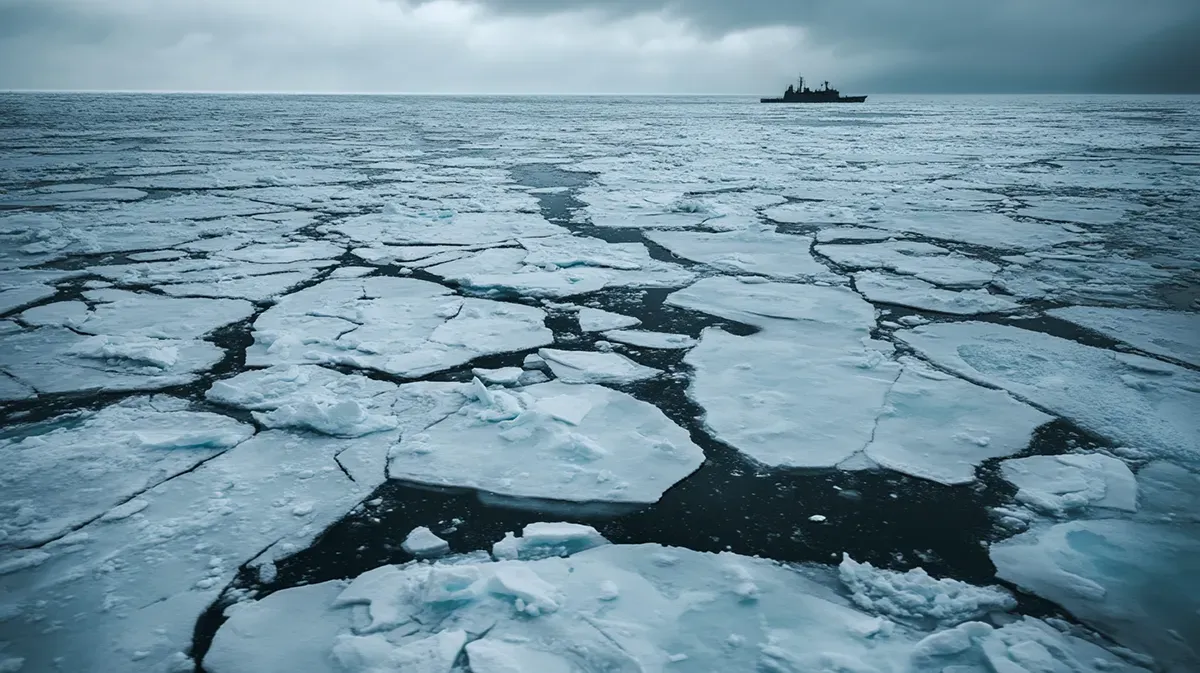
A warming Arctic does not reduce rivalry. It increases the value of control.
Arctic sea ice has been shrinking for decades, but the change is no longer abstract. In March 2025, Arctic winter sea ice reached the lowest annual maximum in the satellite record. Authorities in both the United States and Europe reported the same result: ice cover peaked at a historic low before beginning its seasonal retreat.
The direction is unmistakable. The ice is thinner, less stable and less dependable than before. That changes the practical conditions for shipping, extraction and military operations across the High North.
The most familiar story is that a warmer Arctic will create a major new trade corridor between Europe and Asia. The logic appears simple. If the route is shorter, it should be commercially superior.
But a shorter route on the map does not create a viable trade corridor. Northern shipping still depends on unstable ice conditions, costly icebreaker support, shallow waters, weak search and rescue capacity, limited port infrastructure and high insurance costs. Geography alone does not produce a profitable route.
What happened along Russia’s Northern Sea Route in 2025 makes that clear. Traffic continued, but it remained narrow, selective and tied to specific cargo flows rather than any broad transformation in global trade.
The summer and autumn season ended with roughly 103 transit voyages and about 3.2 million tons of cargo. The traffic was dominated by tankers, bulk carriers and raw-material shipments, not by any breakthrough in container shipping.
The main transit pattern also remained eastbound from Russia to China. Even liquefied natural gas shipments moving through the route were tied above all to Russian Arctic energy projects, not to the emergence of a general commercial passage linking the world economy in a new way.
The point is not that Arctic shipping is irrelevant. It is that it remains structured by state-backed extraction and selective logistics rather than by open commercial integration.
Geography alone does not produce a profitable route.
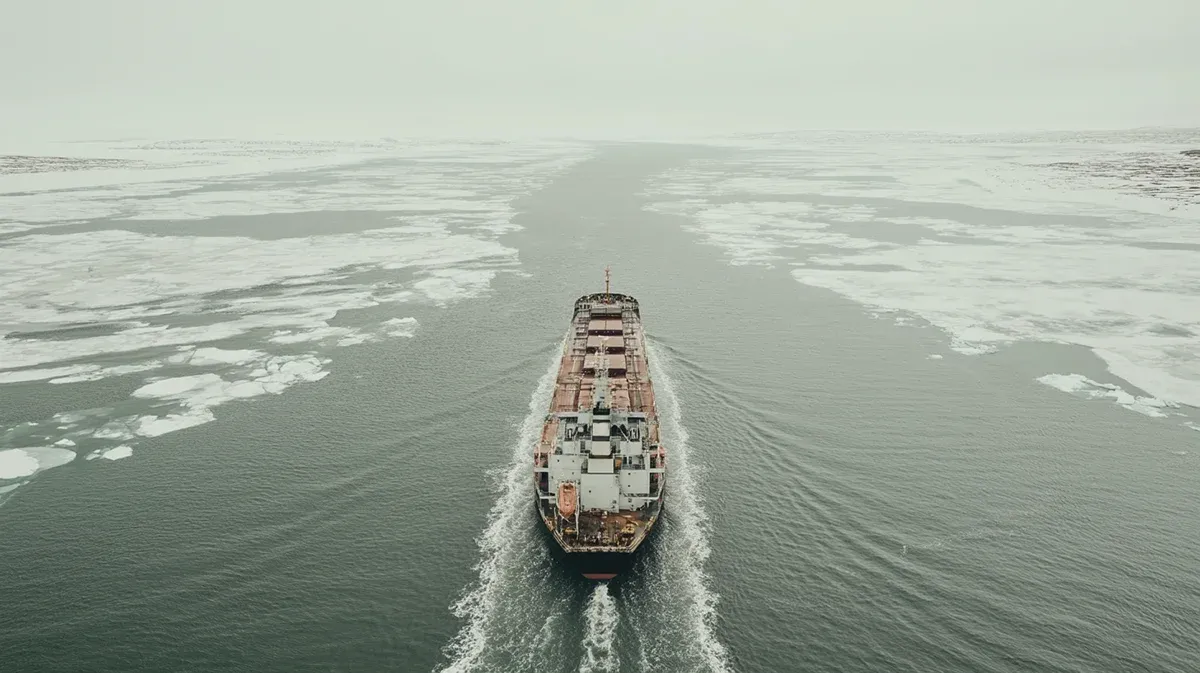
The Arctic route may be shorter on the map, but access still depends on infrastructure, protection and state backing.
That matters because access only becomes valuable when someone can organise it, secure it and profit from it. Ice-free water by itself is not a strategy.
Economic value depends on ports, emergency systems, financing, predictable rules, icebreaker fleets and political protection. In the Arctic, physical change does not weaken state power. It increases the premium on state capacity.
The region is not becoming a borderless market. It is becoming a managed space in which actors with the strongest legal, logistical and military tools can convert access into advantage.
The same logic applies to the resources beneath and around the ice. The Arctic is often described as a storehouse of oil, gas and critical minerals, as if abundance naturally leads to prosperity. It does not.
Resources become strategic assets only when they are legally secured, commercially viable and politically protected. In the Arctic, geology does not determine outcomes. Deposits become power only when states and aligned firms can secure, finance and defend their extraction.
Greenland illustrates this clearly. Mining projects there are no longer just commercial ventures. They are increasingly tied to competition over industrial supply chains and future strategic dependence.
In June 2025, Greenland granted a thirty-year permit for the Malmbjerg molybdenum project, which developers said could cover roughly a quarter of Europe’s demand for the metal. In March 2026, Critical Metals approved a thirty million dollar acceleration programme for the Tanbreez rare earth project in southern Greenland.
Reuters also reported that officials from the United States and Denmark had earlier lobbied the developer not to sell the project to buyers linked to China. This is not a story of remote resources simply being discovered by the market. It is a struggle over who will control the inputs required for future industry and strategic autonomy.
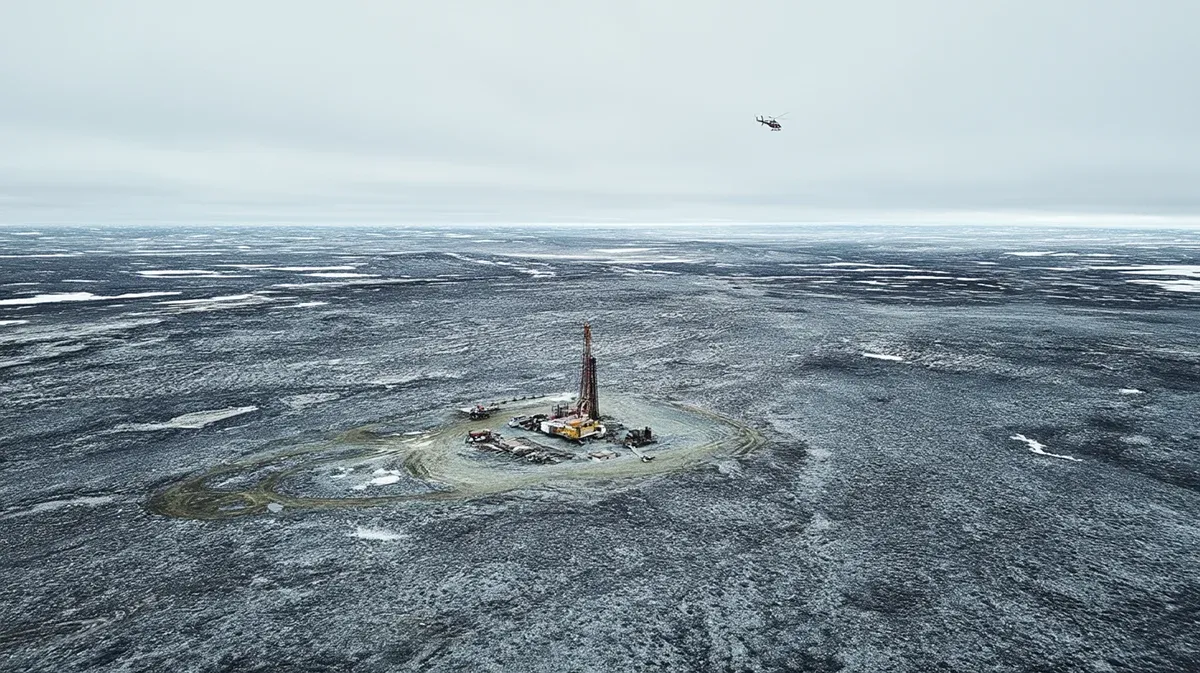
In the Arctic, remote resources become strategic only when states and firms can secure and defend them.
The law of the sea does not make the Arctic less political. It turns power into paperwork, jurisdiction and regulated exclusion.
Conflict in the North is not expressed only through warships and air patrols. It also runs through continental shelf claims, fisheries agreements, licensing systems, environmental rules and administrative authority.
Rivalry has not been displaced by law. It has been institutionalised through filings, permits, jurisdictional claims and regulatory machinery. States are still fighting over control. They are simply doing more of it through bureaucratic means.
Even the cases most often presented as evidence of cooperation reveal how conditional that cooperation has become. The Agreement to Prevent Unregulated High Seas Fisheries in the Central Arctic Ocean remains in force as a precautionary barrier against uncontrolled fishing in waters that are becoming more accessible.
That matters. But the agreement matters precisely because the states involved understand what happens when access improves before rules are settled. Competition accelerates. The agreement does not show that rivalry has faded. It shows that all parties recognise how quickly a new extractive scramble could begin if limits are not imposed in advance.
The question of who wins and who pays runs through the entire Arctic transformation. The gains are concentrated among those with ports, fleets, finance, legal leverage, surveillance systems and military backing.
The costs fall elsewhere: environmental risk, emergency burdens, social disruption and growing pressure on local communities whose ability to shape the process remains limited.
For Arctic communities and Indigenous peoples, rising strategic value does not translate automatically into greater control. In practice, it often means that key decisions are made elsewhere while risk is localised at home.
The region is becoming more valuable to outside powers at the same time that many of the people who live there still have too little influence over what that value will mean.
Rising strategic value does not translate automatically into greater control.
That imbalance is becoming sharper because security policy now sits much closer to the centre of Arctic politics. For years, the region was often described as an area where practical cooperation could coexist with limited rivalry. That picture has weakened badly since Russia’s full-scale invasion of Ukraine.
The old idea of the Arctic as a partially insulated zone now looks much less convincing.
The Arctic Council illustrates the change. During Norway’s chairship, official diplomatic-level meetings had been paused, and much of the political effort was spent simply trying to preserve enough cooperation for the institution to keep functioning.
When the fourteenth Arctic Council meeting was finally held in April 2025, Norway handed the chairship to the Kingdom of Denmark after what the council itself described as an unprecedented period marked by the suspension of official meetings.
The institution still exists, but existence is not the same as influence. As the Arctic becomes more strategically important, one of its central political forums has become weaker, more constrained and less able to shape outcomes.
At the same time, the military dimension has become impossible to ignore. In October 2025, NATO opened its new Combined Air Operations Centre in Bodø to strengthen command and monitoring capacity in the High North and the Arctic.
In March 2026, the alliance’s Cold Response exercise brought around 25,000 troops from fourteen countries into northern Norway and Finland for large-scale operations in Arctic conditions.
This is not symbolic background activity. It is a visible expansion of allied capacity in a region increasingly defined by surveillance, readiness and control over access.
Russia remains the heaviest military actor in the Arctic by sheer regional weight. Reuters reported in January 2026 that Russia continues to modernise Soviet-era Arctic bases and anchor its posture around the Northern Fleet, even as the Nordic countries, the United States and Canada strengthen their own Arctic capabilities.
Moscow also conducted major naval drills in July 2025 across the Arctic and other theatres, involving more than 150 vessels and 15,000 personnel. In March 2025, Russia accused Norway of militarising Svalbard, which Norway denied.
This matters not only because Russia remains a major Arctic military power in its own right, but because its posture increasingly intersects with a wider strategic alignment against Western control over northern access, logistics and infrastructure.
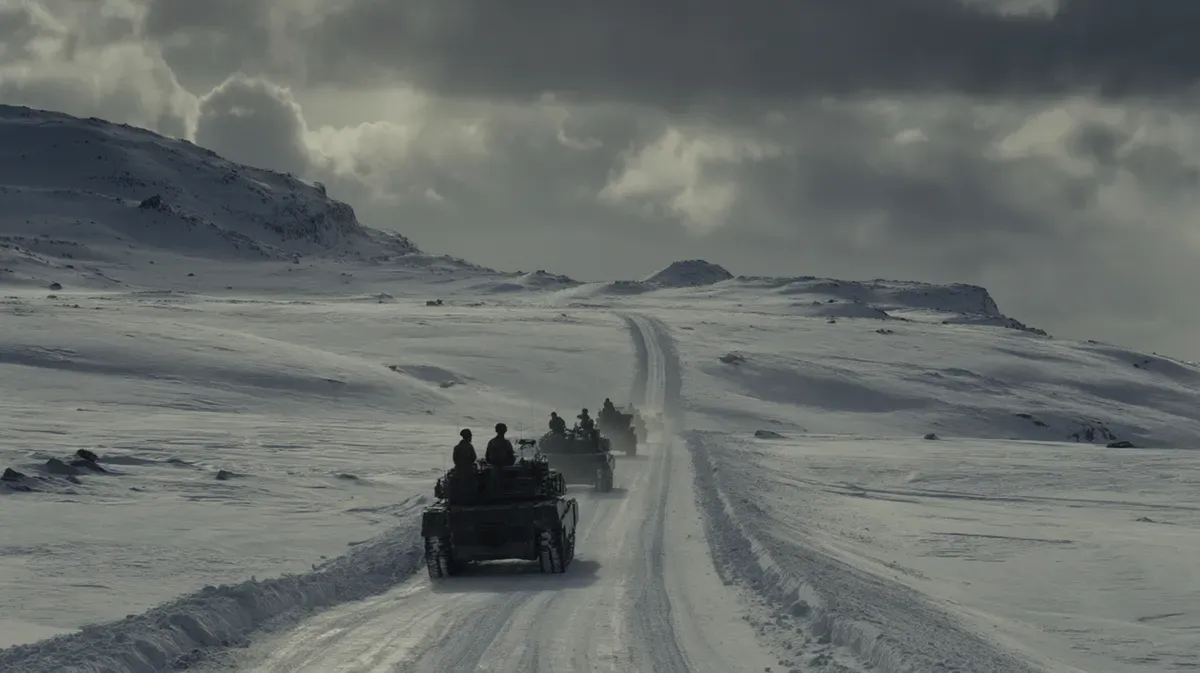
As natural barriers weaken, surveillance, command and military presence become more important.
China deepens that shift. Beijing is not replacing the Arctic states, but it is embedding itself where it can: in shipping plans, energy purchases and mineral supply chains.
Reuters reported that China received twenty-two shipments in 2025 from sanctioned Russian liquefied natural gas projects. In January 2026, NATO’s top military leadership publicly warned that growing cooperation between Russia and China in the Arctic is a source of concern.
The significance is not simply that China has interests in the region and Russia has forces there. It is that the two are increasingly complementary: Russia provides geography, military weight and Arctic infrastructure; China brings demand, capital and supply-chain reach.
Together, they complicate Western efforts to shape the terms of access and control in the North. The Arctic is therefore no longer just a regional arena of overlapping national interests. It is becoming part of a broader contest in which Russia and China, in different but increasingly connected ways, challenge the Western ability to set the rules.
The result is a harder and less stable Arctic order. Rules and agreements still matter, and in some cases they still reduce friction. But they no longer cancel out the broader direction of travel: lower trust, heavier military planning and more openly strategic competition over shipping lanes, airspace, seabed claims and resource access.
Risk rises when diplomatic mechanisms weaken at the same time that states expand their capacity to project force.
The Arctic can no longer be understood by separating climate, transport, resources and security into different categories. They are converging. As the ice retreats, transport and extraction become more feasible. That raises the value of controlling waters, infrastructure, regulations and supply chains.
It increases the importance of state capacity. And when that capacity is increasingly military as well as legal and economic, the region is pulled deeper into great-power rivalry.
The Arctic is not simply opening. It is being reorganised around unequal control over access, extraction and security. The benefits are flowing toward states and companies with the power to set terms, while many of the risks are pushed onto local communities and fragile ecosystems with far less influence over the process.
That is not an accidental side effect of change. It is part of the order now taking shape in the North.
The region is not entering a new era without borders. It is entering a phase in which weaker natural barriers make political and military control more important than before.
The decisive actors will not necessarily be those who move first, but those who can decide who gets to move, on what terms and at whose expense. The ice is disappearing. The struggle over power, access and control is not.
The ice is disappearing. The struggle over power, access and control is not.